A good library for developing Peer-To-Peer applications is being developed by me and a friend. The aim is to enable ease of development of a Peer to Peer System. For now, you can write a peer as
public class MyOwnPeer extends Peer
{
//implement few methods!
}
The peers identify each other through IP Multicasting. In a day or two, I hope to write a short tutorial on how to develop a P2P chat application using our library. For now, it runs within private networks only. And does not run across internet!
Also the library at its current stage enables very easy development of Server application! you can write your echo server without having to worry about threading or anything else!
It is as simple as
public class EchoServer extends ServerComponent
{
//implement few methods!
}
We hope to release the library as early as possible.
The echo server sample is shown below!
Isnt' that easy! This is just the very initial stages of development and hopefully the library grows to something really big. The library relies heavily on Object-Oriented Concepts !
// SAMPLE SERVER CODE!!
class EchoServer extends ServerComponent {
public EchoServer(int port) {
super(port);
}
@Override
public void beforeServerStarts() {
System.out.println("Server about to start");
}
@Override
public void onIncomingConnection(Socket socket) {
try {
BufferedReader buff = new BufferedReader(new InputStreamReader(
socket.getInputStream()));
PrintWriter pw = new PrintWriter(socket.getOutputStream());
String temp = "";
while ((temp = buff.readLine()) != null) {
pw.println(temp);
pw.flush();
}
} catch (IOException e) {
// TODO Auto-generated catch block
e.printStackTrace();
}
}
@Override
public void onServerStarted() {
System.out.println("Server Started!");
}
public static void main(String[] args) {
EchoServer my = new EchoServer(1233);
}
}
Sunday, October 28, 2007


Saturday, October 27, 2007
Good .NET Reflector
Download this good tool called "lutz roeder's .net reflector" from the link below
http://www.aisto.com/roeder/dotnet/
Using this one could load a .NET assembly and decompile it to see the source code and do something more. I saw this tool being used in one of the C#3.0 Nuggets (I think it was in Object Initializers video). This could be used to understand how compiler takes in our source code and modifies it well!
I knew unused variables in your source code would not be included but it was something really fun to check it out.
I gave two unused variables and a used variable and when I decompiled the code, I found the two unused variables not mentioned at all! there is the proof!
http://www.aisto.com/roeder/dotnet/
Using this one could load a .NET assembly and decompile it to see the source code and do something more. I saw this tool being used in one of the C#3.0 Nuggets (I think it was in Object Initializers video). This could be used to understand how compiler takes in our source code and modifies it well!
I knew unused variables in your source code would not be included but it was something really fun to check it out.
I gave two unused variables and a used variable and when I decompiled the code, I found the two unused variables not mentioned at all! there is the proof!
C# 3.0 - Changes ! Learn them Quick!
Thanks to Mike Taulty, famous for MSDN Nuggets, that I started to learn LINQ. Will post the exact link sometime later.
But these are the various LINQ techs coming up:
1. LINQ to SQL
2. LINQ to XML
3. LINQ to Entities
4. DLinq
5. BLinq
and much more.
Before that I would recommend to learn the new changes in C# 3.0. The nuggets could be found here
http://www.microsoft.com/uk/msdn/nuggets/tags/C%23%20Version%203.0/default.aspx?pg=1
I am yet to watch these videos and once done! I would post some hello world! kind of programs that can help people like me to learn easily. Most of these videos usually use a very complex kind of examples and sometimes it is good while sometimes it is not so good!
More later...
But these are the various LINQ techs coming up:
1. LINQ to SQL
2. LINQ to XML
3. LINQ to Entities
4. DLinq
5. BLinq
and much more.
Before that I would recommend to learn the new changes in C# 3.0. The nuggets could be found here
http://www.microsoft.com/uk/msdn/nuggets/tags/C%23%20Version%203.0/default.aspx?pg=1
I am yet to watch these videos and once done! I would post some hello world! kind of programs that can help people like me to learn easily. Most of these videos usually use a very complex kind of examples and sometimes it is good while sometimes it is not so good!
More later...
Saturday, October 20, 2007
CapGemini Second Round of Interview
I had my second round of interview at CapGemini TME Office at Atlanta. It was a great office, looking very much like my old office at Kanbay, but the difference being everyone had their own private cubicles unlike at Kanbay. The interviewer Mr. Micheal talked to me about the pros and cons of having a common space for everyone. Anyway coming to the interview aspects, it was everything about behavioral aspects of a consultant. I was kind of under-prepared for this kind of an interview and add to that the candidates whom I met during my wait time, most of them from GaTech! That kind of put me off to a defensive stand, come on everyone would be afraid to meet top notch engineers, consultants from a top-notch College. And it took me quite a long time to get into the "good" mode that is needed to do an interview well.
Well coming to the experiences part, I really think that it depends at least 50% on the interviewer that impacts your performance during an interview. The first round was not all that great, the interviewer had my resume, he had a list of questions, almost four pages long and I was all done in 20 mins! isn't that too long and it was kind of mechanical, routine nothing that exciting to make me talk a lot about my experiences. I think I did well on that. I was asked a series of questions and all of these were behavioral. They tested you as a team leader, as a motivator as a problem solver. They test your team leadership skills more than what they talk about your academics. questions like tell me a situation when you had too little time to a lot of things, tell me a time when you went through a lot of stress and how did you cope it. I think I did fairly well.
The second round was the one I liked the most. It was one of the best interviews I had and I have had interviews with almost 10 different people and it was a really great interview. Again, I was tested on the very same things - leadership, motivation skills, commitment, learning ability.
I think I did well. I am not sure if it is often the case, but this is the first time I have been walked out of the interview till the exit door by the interviewer himself and he appeared to be very impressed.
Irrespective of the result, I think I had a terrific experience of getting interviewed at CapGemini, especially my first round of interview with Spencer Lentz and the final interview with Micheal. Both were amazing people with great interviewing skills. I hope everyone of my friends would get such a great interviewers for their interview.
If anyone reading these posts need some light on CapGemini interviews please leave me a message at krishnabhargav@yahoo.com!
Well coming to the experiences part, I really think that it depends at least 50% on the interviewer that impacts your performance during an interview. The first round was not all that great, the interviewer had my resume, he had a list of questions, almost four pages long and I was all done in 20 mins! isn't that too long and it was kind of mechanical, routine nothing that exciting to make me talk a lot about my experiences. I think I did well on that. I was asked a series of questions and all of these were behavioral. They tested you as a team leader, as a motivator as a problem solver. They test your team leadership skills more than what they talk about your academics. questions like tell me a situation when you had too little time to a lot of things, tell me a time when you went through a lot of stress and how did you cope it. I think I did fairly well.
The second round was the one I liked the most. It was one of the best interviews I had and I have had interviews with almost 10 different people and it was a really great interview. Again, I was tested on the very same things - leadership, motivation skills, commitment, learning ability.
I think I did well. I am not sure if it is often the case, but this is the first time I have been walked out of the interview till the exit door by the interviewer himself and he appeared to be very impressed.
Irrespective of the result, I think I had a terrific experience of getting interviewed at CapGemini, especially my first round of interview with Spencer Lentz and the final interview with Micheal. Both were amazing people with great interviewing skills. I hope everyone of my friends would get such a great interviewers for their interview.
If anyone reading these posts need some light on CapGemini interviews please leave me a message at krishnabhargav@yahoo.com!
Monday, October 08, 2007
Interview with CapGemini
I have tried to search for some links which would give me some information on interviewing with CapGemini U.S but could not find any thing that was free. Well, I thought I would share some of my experiences. I had an interview with CapGemini today at UGA with a Senior Manager and I guess I cannot mention his name without his consent.
Anyway the interview was for "Staff Technical Consulting". It was more about conversational interview and we did not talk much about technical aspects. The interviewer, I guess was looking for more on the behavioral aspects of me, as a prospective consultant. The questions were more on the lines of "describe a situation where you motivated a team", "describe a situation where you had a lot of work to do and less time", etc.
I think I did a good job, I answered the questions and let us see if i can make it.
For those who would attend a similar interview, in case you need some more information feel free to mail me at krishnabhargav@yahoo.com
Anyway the interview was for "Staff Technical Consulting". It was more about conversational interview and we did not talk much about technical aspects. The interviewer, I guess was looking for more on the behavioral aspects of me, as a prospective consultant. The questions were more on the lines of "describe a situation where you motivated a team", "describe a situation where you had a lot of work to do and less time", etc.
I think I did a good job, I answered the questions and let us see if i can make it.
For those who would attend a similar interview, in case you need some more information feel free to mail me at krishnabhargav@yahoo.com
Project SoccerBots - Soccer Simulator in C#/.NET
I started the work to port Soccer Simulator which I wrote in Java on to .NET. I am using C# and making heavy use of User Controls to render efficient animation. So far, things are going on well and I hope in the next two weeks, I would be able to upload the project and release it as an Open Source Software at http://www.codeplex.com/soccersim
The basic idea is to simulate soccer game where two teams compete against each other. A user can write his own team and then make the Simulator play that team. In my Java version, which has some bugs and does not run that great, teams are written in Java. As an extension I am planning to support XML teams in my new simulator so that any one who loves games and who know little XML can use the software. I guess it would be more acceptable. The current simulator is inspired from both my original Java version as well as some ideas taken from the Ascii soccer developed by Prof. Tucker Balch and Dr. Maria Hybinette. The details are in this link
http://www.cs.uga.edu/~maria/classes/8220-Fall-2007/project1soccer.html
By the way I am in one of the pictures in that class website.
Dr. Tucker also has this TEAMBOTS which is a more advanced and a great Soccer Simulator written in Java. Though, I am not refering the code from that simulator, might be I would try it out to see if I can add a feature or two.
A friend of mine is helping me on this project and this would be released as a collective effort. The deadline is November 4th and before that we plan to release the SoccerBots 0.5 BETA!
The basic idea is to simulate soccer game where two teams compete against each other. A user can write his own team and then make the Simulator play that team. In my Java version, which has some bugs and does not run that great, teams are written in Java. As an extension I am planning to support XML teams in my new simulator so that any one who loves games and who know little XML can use the software. I guess it would be more acceptable. The current simulator is inspired from both my original Java version as well as some ideas taken from the Ascii soccer developed by Prof. Tucker Balch and Dr. Maria Hybinette. The details are in this link
http://www.cs.uga.edu/~maria/classes/8220-Fall-2007/project1soccer.html
By the way I am in one of the pictures in that class website.
Dr. Tucker also has this TEAMBOTS which is a more advanced and a great Soccer Simulator written in Java. Though, I am not refering the code from that simulator, might be I would try it out to see if I can add a feature or two.
A friend of mine is helping me on this project and this would be released as a collective effort. The deadline is November 4th and before that we plan to release the SoccerBots 0.5 BETA!
Wednesday, September 19, 2007
Send Keys in Java or automate repetitive tasks programmatically.
If you have ever programmed in VB, you will definitely know what SendKeys are. You can use send keys function in vb to send in keystrokes to other applications, to be specific to that application which has focus. You can do similar work in Java.
You have send keys like functionality in java.awt.Robot class. You can instantiate a Robot class and then use methods like keyPress(KeyEvent.ENTER), keyRelease, mouseMove, mouseClick, etc.
This is very useful. Like I mentioned in the previous posts, I am running certain tests using Browser Widget. And I am not always infront of the system. And I do get a lot of dialog pop-ups which require a user to manually click OK. I mentioned about wmctrl in the previous posts but I did not get to send keys from wmctrl, so here is what I did.
I used wmctrl to get a list of open windows and specifying -x option to wmctrl would give you even the WM_CLASS and based on this, I use -a option to bring the particular window on top. Then once when the window is on top, I use Robot class to send keys.
There are other good tools like Expect scripts, Devilspie which can automate tasks but I did not have enough time to learn them from scratch. EXPECT is more prominent out there but Devilspie too looked promising.
You have send keys like functionality in java.awt.Robot class. You can instantiate a Robot class and then use methods like keyPress(KeyEvent.ENTER), keyRelease, mouseMove, mouseClick, etc.
This is very useful. Like I mentioned in the previous posts, I am running certain tests using Browser Widget. And I am not always infront of the system. And I do get a lot of dialog pop-ups which require a user to manually click OK. I mentioned about wmctrl in the previous posts but I did not get to send keys from wmctrl, so here is what I did.
I used wmctrl to get a list of open windows and specifying -x option to wmctrl would give you even the WM_CLASS and based on this, I use -a option to bring the particular window on top. Then once when the window is on top, I use Robot class to send keys.
There are other good tools like Expect scripts, Devilspie which can automate tasks but I did not have enough time to learn them from scratch. EXPECT is more prominent out there but Devilspie too looked promising.
Saturday, September 15, 2007
Configuring SWT Browser Widget Preferences!
This technique I discovered works on Linux, ie. when SWT Browser uses Mozilla as its underlying browser. It uses JavaXPCOM to connect with Mozilla and does great job doing so. But then the Browser class do not have any options to configure the preferences of the browser. But you can still configure the preferences of the browser!!
Mozilla preferences are stored in a .mozilla directory for each user, in their home directory. Thanks to Dr. Li, that I could find this out. Now if you run a program that uses SWT Browser, you can see a a folder "Eclipse" inside this .mozilla directory.
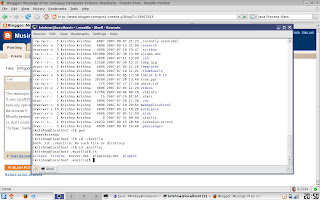 [Note I am talking about running a Java Program which has SWT Browser, from ECLIPSE, thus the folder name is eclipse. If you run from console, you might have a different foldername(I guess as that of the program name)]
It is in the /home//.mozilla/eclipse directory that the SWT Browser used Mozilla preferences are stored. It is stored in the prefs.js javascript file. You can specify a user prefernces by using user_pref() function. For example, you want a network boosted SWT Browser widget, then may be you can add the following line to prefs.js
user_pref("networking.http.pipelining",true);
Close Eclipse and start again. Now when you launch the program, the browser would use this preference.
Another way is to use "about:config" within your program do the configuration!
For this you can just write a configure() function and use it when you want. The function can be something like
Class ConfigurationWindow
{
public void configure()
{
Display display = new Display();
Shell shell = new Shell(display);
Browser browser = new Browser(shell,SWT.CENTER);
shell.setLayout(new GridLayout());
browser.setUrl("about:config");
shell.open();
while(!shell.isDisposed())
if(!display.readAndDispatch()) display.sleep();
shell.dispose();
display.dispose();
browser.dispose();
}
}
Now you can create new instance of ConfigurationWindow and call configure() which shows the user preferences window, just like the one you get when you type about:config in Mozilla Firefox.
This way one can configure preferences for Swt Browser Widget!
Mozilla preferences are stored in a .mozilla directory for each user, in their home directory. Thanks to Dr. Li, that I could find this out. Now if you run a program that uses SWT Browser, you can see a a folder "Eclipse" inside this .mozilla directory.
 [Note I am talking about running a Java Program which has SWT Browser, from ECLIPSE, thus the folder name is eclipse. If you run from console, you might have a different foldername(I guess as that of the program name)]
It is in the /home/
user_pref("networking.http.pipelining",true);
Close Eclipse and start again. Now when you launch the program, the browser would use this preference.
Another way is to use "about:config" within your program do the configuration!
For this you can just write a configure() function and use it when you want. The function can be something like
Class ConfigurationWindow
{
public void configure()
{
Display display = new Display();
Shell shell = new Shell(display);
Browser browser = new Browser(shell,SWT.CENTER);
shell.setLayout(new GridLayout());
browser.setUrl("about:config");
shell.open();
while(!shell.isDisposed())
if(!display.readAndDispatch()) display.sleep();
shell.dispose();
display.dispose();
browser.dispose();
}
}
Now you can create new instance of ConfigurationWindow and call configure() which shows the user preferences window, just like the one you get when you type about:config in Mozilla Firefox.
This way one can configure preferences for Swt Browser Widget!
Linux Window Management - When you are away from the PC

Like I mentioned in the previous posts, I have this requirement where I run tests using SWT Browser Widget on thousands of URLs. And I am start the test and leave the lab. But then for some URL, the SWT Browser just pops up a dialog either asking for password or warning about a bad certificate. This has been my biggest problem off late and has delayed my tests because unless you close the dialogs the program, the execution cannot move forward.(Like the one shown in the image)
I tried out various options like configuring the settings of Mozilla which is used by SWT Browser when the widget runs on Linux (It uses IE when is running on Windows). But this hasnt worked out.
Then I thought, in Linux if a window is created, there is some way that we can be notified about this. Like some kind of GNOME or a X window Events. So initially I thought I would write some program in C to capture these global events and then for those windows I want, I would close them as I get notified. But then unlike getting this idea, implementing it is not that simple. Even now I have no clue if I ever want to write such a program, then what should I start.
Anyways I browsed for a long time and found out about this wonderful new tool called "wmctrl" which does exactly what I want. With wmctrl I can get a list of open windows, their X Window ID, their title, their process IDs. And not only that we can manage a specific window using its ID or title and this includes opening, closing, resize, move, change title, etc. Isnt that great?
You can download it from "http://www.sweb.cz/tripie/utils/wmctrl/". Just install the tool on your machine using ./configure, make, make install and you are good to go.
Getting a list of open windows on Linux
In the command line, type in wmctrl -l to get a list of all open windows and their information. Example shown in the image.

The other options are also shown. You can close a window by passing its ID (-i option) and a -c option.
You can close a window by just passing the title along with -c option.
But then the next problem is how am I going to execute this from a Java Program!
Executing Linux Commands from Java Program
You can run a Unix command from a Java Program, as shown below
try {
Process p = Runtime.getRuntime().exec("wmctrl -l -p");
int i = p.waitFor(); // very important. You wait for the command to be executed.
// i would be the return value of the process you are running.
if(i==0) //if successfully terminated
{
BufferedReader buff = new BufferedReader(new InputStreamReader(p.getInputStream()));
String temp;
while((temp=buff.readLine())!=null)
{
System.out.println(temp);
}
}
else //wmctrl returns 1 if no options passed
System.out.println("error : "+i);
} catch (IOException e) {
// TODO Auto-generated catch block
e.printStackTrace();
} catch (InterruptedException e) {
// TODO Auto-generated catch block
e.printStackTrace();
}
The above program executes wmctrl and displays the listing on the console. Isn't Java interesting to work and great?
I am just left with implementing this idea on my lab test machine and collect great results!!!!
Friday, September 14, 2007
BUG in SWT Browser Widget
I have just discovered a bug in SWT Browser Widget which is used by Eclipse for its internal browser. Just type in http://www.friendster.com/ anyway inside eclipse (some editor inside eclipse). Hold CTRL and click on that link to open Eclipse internal browser. As the page is about to finish loading, Eclipse closes!!
The version I am using is SWT 3.3, the latest, so called stable release.
No idea as of now why this is happening. I guess there is some component inside friendster.com homepage that SWT Browser widget does not like much, and infact it is a VM error!
By the way I am running Fedora Core 7.
The version I am using is SWT 3.3, the latest, so called stable release.
No idea as of now why this is happening. I guess there is some component inside friendster.com homepage that SWT Browser widget does not like much, and infact it is a VM error!
By the way I am running Fedora Core 7.
Thursday, September 13, 2007
Small Read from file, write to file utility
A Java Class that I wrote for my own use. Just to have ease of access.....
--------------------------------------------------------------------------------------------------
package buddi.thesis;
import java.io.BufferedReader;
import java.io.File;
import java.io.FileNotFoundException;
import java.io.FileReader;
import java.io.IOException;
import java.io.PrintWriter;
public class DataStore {
private PrintWriter writer=null;
private BufferedReader reader=null;
public DataStore(String input, String output)
{
try {
reader = new BufferedReader(new FileReader(input));
writer = new PrintWriter(new File(output));
} catch (FileNotFoundException e) {
e.printStackTrace();
}
}
public String getNextItem()
{
if(reader==null)
return null;
String temp;
try {
temp = reader.readLine();
if(temp!=null)
return temp;
} catch (IOException e) { }
return null;
}
public void writeToOutput(String text)
{
if(writer==null)
{
System.out.println("ERROR : COULD NOT WRITE TO OUTPUT!");
return;
}
writer.println(text);
writer.flush();
}
public void close()
{
try {
reader.close();
writer.close();
reader=null;
writer=null;
} catch (IOException e) {
}
}
}
--------------------------------------------------------------------------------------------------
package buddi.thesis;
import java.io.BufferedReader;
import java.io.File;
import java.io.FileNotFoundException;
import java.io.FileReader;
import java.io.IOException;
import java.io.PrintWriter;
public class DataStore {
private PrintWriter writer=null;
private BufferedReader reader=null;
public DataStore(String input, String output)
{
try {
reader = new BufferedReader(new FileReader(input));
writer = new PrintWriter(new File(output));
} catch (FileNotFoundException e) {
e.printStackTrace();
}
}
public String getNextItem()
{
if(reader==null)
return null;
String temp;
try {
temp = reader.readLine();
if(temp!=null)
return temp;
} catch (IOException e) { }
return null;
}
public void writeToOutput(String text)
{
if(writer==null)
{
System.out.println("ERROR : COULD NOT WRITE TO OUTPUT!");
return;
}
writer.println(text);
writer.flush();
}
public void close()
{
try {
reader.close();
writer.close();
reader=null;
writer=null;
} catch (IOException e) {
}
}
}
Wednesday, September 12, 2007
Java Program to detect Server side redirections!
As a part of my research work, I wrote this small function in Java which gives you HTTP Response Code and with which we can actually detect server side redirects. The server side redirects have a response code as 302. Well here is the program,
public class NetworkTool {
public static int getResponseCode(String url) {
try {
URL urlItem = new URL(url);
HttpURLConnection con = (HttpURLConnection) urlItem.openConnection();
con.setReadTimeout(1000);
con.setConnectTimeout(5000);
//System.out.println(con.getConnectTimeout());
con.setInstanceFollowRedirects(false);
int res = con.getResponseCode();
return res;
} catch (MalformedURLException e) {
// TODO Auto-generated catch block
//e.printStackTrace();
} catch (IOException e) {
// TODO Auto-generated catch block
//e.printStackTrace();
}
catch(Exception ex){//System.out.println("hehe");
}
return -1;
}
public static void main(String[] args)
{
System.out.println(getResponseCode("http://cs.uga.edu/index.htmx"));
System.out.println(getResponseCode("http://buddibuddibuddi.com"));
System.out.println(getResponseCode("http://128.192.1.21"));
}
}
The statements highlighted in bold are important. Otherwise, there are some url for which you get connected to the server but you keep waiting for infinite time for the data to come on the connection. So if we set time-out on read, we don't wait for long and this is especially helpful when you run the tests on huge data.
It took me quite a long time to get the actual code fixed, and then to find out the two statements. So I hope this post would be useful for others too.
public class NetworkTool {
public static int getResponseCode(String url) {
try {
URL urlItem = new URL(url);
HttpURLConnection con = (HttpURLConnection) urlItem.openConnection();
con.setReadTimeout(1000);
con.setConnectTimeout(5000);
//System.out.println(con.getConnectTimeout());
con.setInstanceFollowRedirects(false);
int res = con.getResponseCode();
return res;
} catch (MalformedURLException e) {
// TODO Auto-generated catch block
//e.printStackTrace();
} catch (IOException e) {
// TODO Auto-generated catch block
//e.printStackTrace();
}
catch(Exception ex){//System.out.println("hehe");
}
return -1;
}
public static void main(String[] args)
{
System.out.println(getResponseCode("http://cs.uga.edu/index.htmx"));
System.out.println(getResponseCode("http://buddibuddibuddi.com"));
System.out.println(getResponseCode("http://128.192.1.21"));
}
}
The statements highlighted in bold are important. Otherwise, there are some url for which you get connected to the server but you keep waiting for infinite time for the data to come on the connection. So if we set time-out on read, we don't wait for long and this is especially helpful when you run the tests on huge data.
It took me quite a long time to get the actual code fixed, and then to find out the two statements. So I hope this post would be useful for others too.
Tuesday, September 11, 2007
Some interesting figures...
I was wondering how many elements of a type can you store in a
1. HashMap
2. Vector
3. ArrayList
4. Stack
and other Collections.
This is what i found. With the default Heap space intact,
ArrayList can store 33,07,499 Long or Integers and around 1222441 Strings(I am not sure how long)
Stack and Vector, including HashMap can store upto 1236653 Strings. While around 26,21,441 integral types could be stored.
I am not sure if this is same across all machines. Well this atleast gives me an idea to what extent i can go without facing OutOfMemoryError.
1. HashMap
2. Vector
3. ArrayList
4. Stack
and other Collections.
This is what i found. With the default Heap space intact,
ArrayList can store 33,07,499 Long or Integers and around 1222441 Strings(I am not sure how long)
Stack and Vector, including HashMap
I am not sure if this is same across all machines. Well this atleast gives me an idea to what extent i can go without facing OutOfMemoryError.
How do you construct absolute URL for links in the web page?
Suppose you crawl a page at http://cs.uga.edu/~krishna and one of the HREF links to contact.html, then how do you get the absolute URL for the contact.html ? We can say simply concatenate the original HREF to contact.html, but then it is not that simple. There might be cases where the href was "../../../../contact.html", we need to take into account those cases too. So the simplest way that I found was to use URL class in the java.net package. And the following code does the trick for us.
URL start = new URL("http://cs.uga.edu/~krishna");
URL newUrl = new URL(start,"contact.html"); //construct the absolute URL
Thats the way you construct absolute URL. Very simple, isn't it?
URL start = new URL("http://cs.uga.edu/~krishna");
URL newUrl = new URL(start,"contact.html"); //construct the absolute URL
Thats the way you construct absolute URL. Very simple, isn't it?
Thursday, September 06, 2007
File URIs
URI - Uniform Resource Identifier
A URI for a web resource might be http://krishnabhargav.blogspot.com
Most of the api might require you to specify URI for local files instead of having a local path. Suppose you want to pass a local system file as a parameter and it should be in the form of an URI then you can do this:
Let us say the file is D:/Development/MyResource.txt
Then the fileUri would be something like
file:///D:/Development/MyResource.txt
One most common mistake is to use file:// instead of file:///. We go by the notion that http has "//" and so does ftp. So even this "file" would have "//" in its Uri. But it is "///" instead of "//".
One good and more detailed explanation is given here.
http://blogs.msdn.com/ie/archive/2006/12/06/file-uris-in-windows.aspx
I really appreciate his post.
A URI for a web resource might be http://krishnabhargav.blogspot.com
Most of the api might require you to specify URI for local files instead of having a local path. Suppose you want to pass a local system file as a parameter and it should be in the form of an URI then you can do this:
Let us say the file is D:/Development/MyResource.txt
Then the fileUri would be something like
file:///D:/Development/MyResource.txt
One most common mistake is to use file:// instead of file:///. We go by the notion that http has "//" and so does ftp. So even this "file" would have "//" in its Uri. But it is "///" instead of "//".
One good and more detailed explanation is given here.
http://blogs.msdn.com/ie/archive/2006/12/06/file-uris-in-windows.aspx
I really appreciate his post.
Wednesday, September 05, 2007
Using JAva 6 New Scripting Capabilities
I was working on my thesis work where I had a requirement to execute certain code snippets of JavaScript and see if they make calls or modify a specific set of objects. For example, I wanted to see if the code I wish to run sets "location" property. So I wanted to use the Rhino Engine to execute the Javascript and the major problem with that is that Rhino is just an engine for JavaScript and does not provide any DOM API. So any DOM calls made in the JavaScript would terminate the execution. So we have to expose a set of objects by ourselves to the engine. Anyway in the mean time I came across an article which used Java 6 Scripting Engines! I knew Java 6 had some scripting facilities but never gave it a hard thought. It is a really simple API and works really well. In the past I have tried to use Rhino to run javascript but it is really a tedious process. anyway here is how it is done using javax.script package.
import java.io.FileNotFoundException;
import java.io.FileReader;
import javax.script.ScriptEngineManager;
import javax.script.ScriptException;
import com.sun.script.javascript.RhinoScriptEngine;
public class TestScripting {
public static void main(String[] args)
{
ScriptEngineManager mgr = new ScriptEngineManager();
RhinoScriptEngine js = (RhinoScriptEngine)mgr.getEngineByName("js");
try {
js.put("location",new TestScripting()); // tell the script engine to use the object passed when it encounters "location"
js.eval("function alert(x) { print(x);}"); // implement your own global alert function
try {
js.eval(new FileReader("/home/krishna/workspace/SuriLearning/bin/test.js"));
} catch (FileNotFoundException e) {
// TODO Auto-generated catch block
e.printStackTrace();
}
} catch (ScriptException e) {
// TODO Auto-generated catch block
e.printStackTrace();
}
}
public void write(Object mesg)
{
System.out.println(mesg);
}
public void replace(String mesg)
{
System.out.println("Called location.replace to go to : "+mesg);
}
}
Then I have updated the test.js file with some statement like "location.replace("http://google.com")". This is a basic idea on how we can use Rhino to detect redirections, which is portion of my work.
import java.io.FileNotFoundException;
import java.io.FileReader;
import javax.script.ScriptEngineManager;
import javax.script.ScriptException;
import com.sun.script.javascript.RhinoScriptEngine;
public class TestScripting {
public static void main(String[] args)
{
ScriptEngineManager mgr = new ScriptEngineManager();
RhinoScriptEngine js = (RhinoScriptEngine)mgr.getEngineByName("js");
try {
js.put("location",new TestScripting()); // tell the script engine to use the object passed when it encounters "location"
js.eval("function alert(x) { print(x);}"); // implement your own global alert function
try {
js.eval(new FileReader("/home/krishna/workspace/SuriLearning/bin/test.js"));
} catch (FileNotFoundException e) {
// TODO Auto-generated catch block
e.printStackTrace();
}
} catch (ScriptException e) {
// TODO Auto-generated catch block
e.printStackTrace();
}
}
public void write(Object mesg)
{
System.out.println(mesg);
}
public void replace(String mesg)
{
System.out.println("Called location.replace to go to : "+mesg);
}
}
Then I have updated the test.js file with some statement like "location.replace("http://google.com")". This is a basic idea on how we can use Rhino to detect redirections, which is portion of my work.
Monday, August 13, 2007
my views on destiny
Life goes on with or without a person being happy. There is nothing that one can do in particular about being happy. I have tried my best to lead a disciplined life, the life that one who loves me feels proud about. But it is all trash, that i got to know after a few years of toil and few months of severe pain. You will have to face what it comes towards you even if you are principled or would want to lead a normal life. Doing good to others would take you no where and if you think your doing good to others would ensure you a peaceful life, then you are mistaken. It is these very principles that would make you suffer the most. If you had been not so principled then you would not give a damn about others and then when a person deserts you, you would not have to worry much because you dont give a damn.
What do you want in life?
Well this is one question that you should never ask yourself, the moment you ask the question, you tend to think on what you dont have in life that you want the most and that makes you extremely unhappy. I know that, I have experienced that. And trust me in most of the cases I am better because I did not ask for something that no one could get. It was just that I was craving for a thing that I dont deserve, I guess. Make sure you dont ask that question to yourself. Trust me, by default its always happiness that you want. Had I got what I wished for the most, then I would definitely be happy. But some lives are that way, they dont get what they want right from the time they get their senses. My life has never been normal, I have seen all types of unhappiness that a normal middle class person can see. Thank to anyone who is responsible that I never had a problem to eat or to live. But then I have seen all kinds of problems - I have seen poverty, I have seen break-ups, I have seen much more complicated things and hell with God, I have seen everything that no one would probably wish to see. Live for your parents and do what they want you to do, then you would be the most happiest person on earth. Do not love any one, because it leaves you with pain and gives you nothing but unhappiness. Anyway unless someone dies, they doesnt know the pain of death.
What do you want in life?
Well this is one question that you should never ask yourself, the moment you ask the question, you tend to think on what you dont have in life that you want the most and that makes you extremely unhappy. I know that, I have experienced that. And trust me in most of the cases I am better because I did not ask for something that no one could get. It was just that I was craving for a thing that I dont deserve, I guess. Make sure you dont ask that question to yourself. Trust me, by default its always happiness that you want. Had I got what I wished for the most, then I would definitely be happy. But some lives are that way, they dont get what they want right from the time they get their senses. My life has never been normal, I have seen all types of unhappiness that a normal middle class person can see. Thank to anyone who is responsible that I never had a problem to eat or to live. But then I have seen all kinds of problems - I have seen poverty, I have seen break-ups, I have seen much more complicated things and hell with God, I have seen everything that no one would probably wish to see. Live for your parents and do what they want you to do, then you would be the most happiest person on earth. Do not love any one, because it leaves you with pain and gives you nothing but unhappiness. Anyway unless someone dies, they doesnt know the pain of death.
Friday, July 27, 2007
Installing Toshiba L35-1054 Audio Drivers on Fedora Core 7
The Toshiba L35-1054 Laptop comes with a RealTek Audio Card. In order to install the drivers on Linux (I use Fedora Core 7 which rocks!), first download the driver pack from realtek.com. Given is the straight link for the pack ..
ftp://202.65.194.211/pc/audio/realtek-linux-audiopack-4.06a.tar.bz2
Extract the archive using the tar command passing -xvf options.
tar -xvf realtek-linux-audiopack-4.06a.tar.bz2
Go into the directory that was created during the extraction. You can see a Readme.txt which explains how to install manually or automatically. Since I am a novice I prefer to do it automatically. So I type in
./install
It takes around 10 mins for the drivers to be installed. I had all the needed compilers like the cc,g++ and fortran stuff installed on my box so I did not face any errors. Anyway after installation, restart the system. You might get an error saying device not found. Just check the box asking it not to show the message again. Now you can go to the Sound Card Detection Tool ( I run KDE, it rocks too! - Start -> Administration -> Sound Card Detection). Test the card and you should be able to hear the sound!
Well all the best!
Keywords:
RealTek Audio Drivers
Toshiba Satellite L35-S1054 Audio Drivers
Audio Drivers Linux Fedora Core 7
Installing Audio Drivers on Linux 2.6
ftp://202.65.194.211/pc/audio/realtek-linux-audiopack-4.06a.tar.bz2
Extract the archive using the tar command passing -xvf options.
tar -xvf realtek-linux-audiopack-4.06a.tar.bz2
Go into the directory that was created during the extraction. You can see a Readme.txt which explains how to install manually or automatically. Since I am a novice I prefer to do it automatically. So I type in
./install
It takes around 10 mins for the drivers to be installed. I had all the needed compilers like the cc,g++ and fortran stuff installed on my box so I did not face any errors. Anyway after installation, restart the system. You might get an error saying device not found. Just check the box asking it not to show the message again. Now you can go to the Sound Card Detection Tool ( I run KDE, it rocks too! - Start -> Administration -> Sound Card Detection). Test the card and you should be able to hear the sound!
Well all the best!
Keywords:
RealTek Audio Drivers
Toshiba Satellite L35-S1054 Audio Drivers
Audio Drivers Linux Fedora Core 7
Installing Audio Drivers on Linux 2.6
Monday, July 16, 2007
How to resolve StackOverflowException in Java?
Well, not only when you use deep recursion that you encounter a StackOverflowException but also when you serialize objects you might see this exception.
Well you can always avoid this error by setting a VM option to java, either from eclipse or when you run it from command line, as an argument.
If it is in Eclipse, go to the Run dialog of the current Java program that you wish to run and go to the second tab (arguments I guess) and then in the VM Options you can set "-Xss1024K" which means that any thread that runs on Java VM will be allotted a Stack size of 1 MB which is quite enough for most of the cases.
If you wish to serialize data that has a lot of interlinked references then you might want to keep it something really high, just to be on safer side.
Interesting stuff is going on in the DBMS class at my university and we are learning really good stuff especially the performance oriented nature of DB algorithms! I enjoy the programming assignments, its fun to learn and code!
Well you can always avoid this error by setting a VM option to java, either from eclipse or when you run it from command line, as an argument.
If it is in Eclipse, go to the Run dialog of the current Java program that you wish to run and go to the second tab (arguments I guess) and then in the VM Options you can set "-Xss1024K" which means that any thread that runs on Java VM will be allotted a Stack size of 1 MB which is quite enough for most of the cases.
If you wish to serialize data that has a lot of interlinked references then you might want to keep it something really high, just to be on safer side.
Interesting stuff is going on in the DBMS class at my university and we are learning really good stuff especially the performance oriented nature of DB algorithms! I enjoy the programming assignments, its fun to learn and code!
Thursday, June 07, 2007
Groovy Programming with Eclipse - 3
Let's continue our talk on Numbers and operations.
Arithmetic Operators
1. Addition (+) Operator
2. Subtraction (-) Operator
3. Multiplication (*) Operator
4. Division (/) Operator ( always returns a floating value )
5. Modulus (%) Operator
Example for each of this is shown below.
def num1 = 22;
def num2 = 11;
def add = 22+11; // alternative: 22.plus(11);
def sub = 22-11; // alternative: 22.minus(11);
def mul = 22*11; // alternative: 22.multiply(11);
def div = 22/11; //alternative: 22.div(11);
def rem = 22 % 11; //alternative: 22.mod(11);
Note that div holds 2.0 but not 2 as you expect. If you want integral division, then you should do it as "22.intdiv(11)". intdiv() returns an Integer while a div or / returns a BigDecimal.
The same set of operators holds good for all types of numeric values - integral and non-integral.
Try this : 22.2 % 11; what do you expect would be returned. Well, this is an illegal operation. Since numbers are also objects, the operators +,-,*,etc work because they are "overloaded". Note that multiplicative operators have higher precedence over additive operators(+,-). Also, boolean operators(the comparison operators) have lower precendence over any arithmetic operators.
Other operators of interest are increment and decrement operators. Unary operators are available to increment/decrement a number by 1. For example,
def two = 3-1;
The above statement is perfectly valid. But most of us are already used to do the same using ++ unary operator, which I prefer over anything else if the increment/decrement is by 1. Most of us already know how ++ and -- works. To test if you know, try to guess the output of the simple program shown below:
def v = 10;
def op1 = v++;
def op2 = ++v;
println(op1);
println(op2);
Answers: 10 and 12.
As mentioned earlier, types are assigned at run-time! This is referred to as "dynamic-typing" and this is what makes Groovy a loosely-typed language.
As I mentioned earlier, numbers are objects too! So we have to deal with references. Consider the following snippet.
def num = 12;
def num2 = num;
num++; //will this reflect on num2 too???
println num;
println num2; //guess the output.
it prints 12 and 13. But why?? Both the identifiers refer to the same object. So if one object is modified then the other should be effected too. Isn't it? But the output tells something different The output infact makes sense. When you perform changes on the object itself, then a new object would be created and referred by that identifier. To understand my bad english, try the following code:
def num=12;
def num2 = num;
num2.value++;
println num;
println num2;
Now you can expect the value to be 13 in both the cases! Well justified uh?? by using the "value" property, we are working on the same object! Sharing still maintained!
Boolean/Relational/Comparison Operators
Well as usual <,>,<=,>=,==,!=are comparison or relational operators(also includes the equality operators). Alternative way to do the above said operators is to use compareTo() and equals() methods. For example,
def v1 = 22;
def v2 = 21;
v1.compareTo(v2); //is > 0 in this case.(v1-v2 is ofcourse returned ;)
v1.equals(v2); // returns false.
Note: since the language is loosely typed, i prefer to use .class operator to test what functions/operators bind to what class especially when I try out some new methods. And one last thing to remember is that Garbage collector is always active even when working with plain simple numbers.(ofcourse they are objects !).
In the next post, let us talk about Strings in specific.
I hope atleast one in the world other than me will find this tutorial useful. If so, I appreciate your comments.
Arithmetic Operators
1. Addition (+) Operator
2. Subtraction (-) Operator
3. Multiplication (*) Operator
4. Division (/) Operator ( always returns a floating value )
5. Modulus (%) Operator
Example for each of this is shown below.
def num1 = 22;
def num2 = 11;
def add = 22+11; // alternative: 22.plus(11);
def sub = 22-11; // alternative: 22.minus(11);
def mul = 22*11; // alternative: 22.multiply(11);
def div = 22/11; //alternative: 22.div(11);
def rem = 22 % 11; //alternative: 22.mod(11);
Note that div holds 2.0 but not 2 as you expect. If you want integral division, then you should do it as "22.intdiv(11)". intdiv() returns an Integer while a div or / returns a BigDecimal.
The same set of operators holds good for all types of numeric values - integral and non-integral.
Try this : 22.2 % 11; what do you expect would be returned. Well, this is an illegal operation. Since numbers are also objects, the operators +,-,*,etc work because they are "overloaded". Note that multiplicative operators have higher precedence over additive operators(+,-). Also, boolean operators(the comparison operators) have lower precendence over any arithmetic operators.
Other operators of interest are increment and decrement operators. Unary operators are available to increment/decrement a number by 1. For example,
def two = 3-1;
The above statement is perfectly valid. But most of us are already used to do the same using ++ unary operator, which I prefer over anything else if the increment/decrement is by 1. Most of us already know how ++ and -- works. To test if you know, try to guess the output of the simple program shown below:
def v = 10;
def op1 = v++;
def op2 = ++v;
println(op1);
println(op2);
Answers: 10 and 12.
As mentioned earlier, types are assigned at run-time! This is referred to as "dynamic-typing" and this is what makes Groovy a loosely-typed language.
As I mentioned earlier, numbers are objects too! So we have to deal with references. Consider the following snippet.
def num = 12;
def num2 = num;
num++; //will this reflect on num2 too???
println num;
println num2; //guess the output.
it prints 12 and 13. But why?? Both the identifiers refer to the same object. So if one object is modified then the other should be effected too. Isn't it? But the output tells something different The output infact makes sense. When you perform changes on the object itself, then a new object would be created and referred by that identifier. To understand my bad english, try the following code:
def num=12;
def num2 = num;
num2.value++;
println num;
println num2;
Now you can expect the value to be 13 in both the cases! Well justified uh?? by using the "value" property, we are working on the same object! Sharing still maintained!
Boolean/Relational/Comparison Operators
Well as usual <,>,<=,>=,==,!=are comparison or relational operators(also includes the equality operators). Alternative way to do the above said operators is to use compareTo() and equals() methods. For example,
def v1 = 22;
def v2 = 21;
v1.compareTo(v2); //is > 0 in this case.(v1-v2 is ofcourse returned ;)
v1.equals(v2); // returns false.
Note: since the language is loosely typed, i prefer to use .class operator to test what functions/operators bind to what class especially when I try out some new methods. And one last thing to remember is that Garbage collector is always active even when working with plain simple numbers.(ofcourse they are objects !).
In the next post, let us talk about Strings in specific.
I hope atleast one in the world other than me will find this tutorial useful. If so, I appreciate your comments.
Subscribe to:
Posts (Atom)